When you think of beautifying your outdoor living space, “concrete” and “landscaping” are probably two words you don’t think of together. But half of designing a beautiful backyard is the hardscaping material you use. In this case, as the title suggests, I’m talking about concrete hardscaping.
Concrete isn’t the dull gray slab you probably remember from garage floors, although that’s still an option. Today’s mixes, finishes, and form‑work techniques let us pour nearly any texture, color, or shape imaginable for custom stonework and masonry work, often at a lower cost and with less maintenance than stone or wood.
When we’re planning a San Francisco garden, concrete hardscaping often becomes the quiet backbone that holds the patio level. It anchors hillside retaining walls and terraces, and goes beautifully with both bold plantings and refined hardscape details.
Concrete comes in more styles than you might expect.
Selecting the right concrete format and finish is less about “picking a slab” and more about shaping how your outdoor space will feel, age, and function every single day. Concrete is a chameleon material: in one garden, it’s a monolithic, ultra‑modern plane with razor‑clean saw cuts. In another, it’s a warm, earth‑toned surface that quietly echoes natural stone. Elsewhere, it’s a textured, non‑slip path guiding you through planting beds after a foggy evening mist.
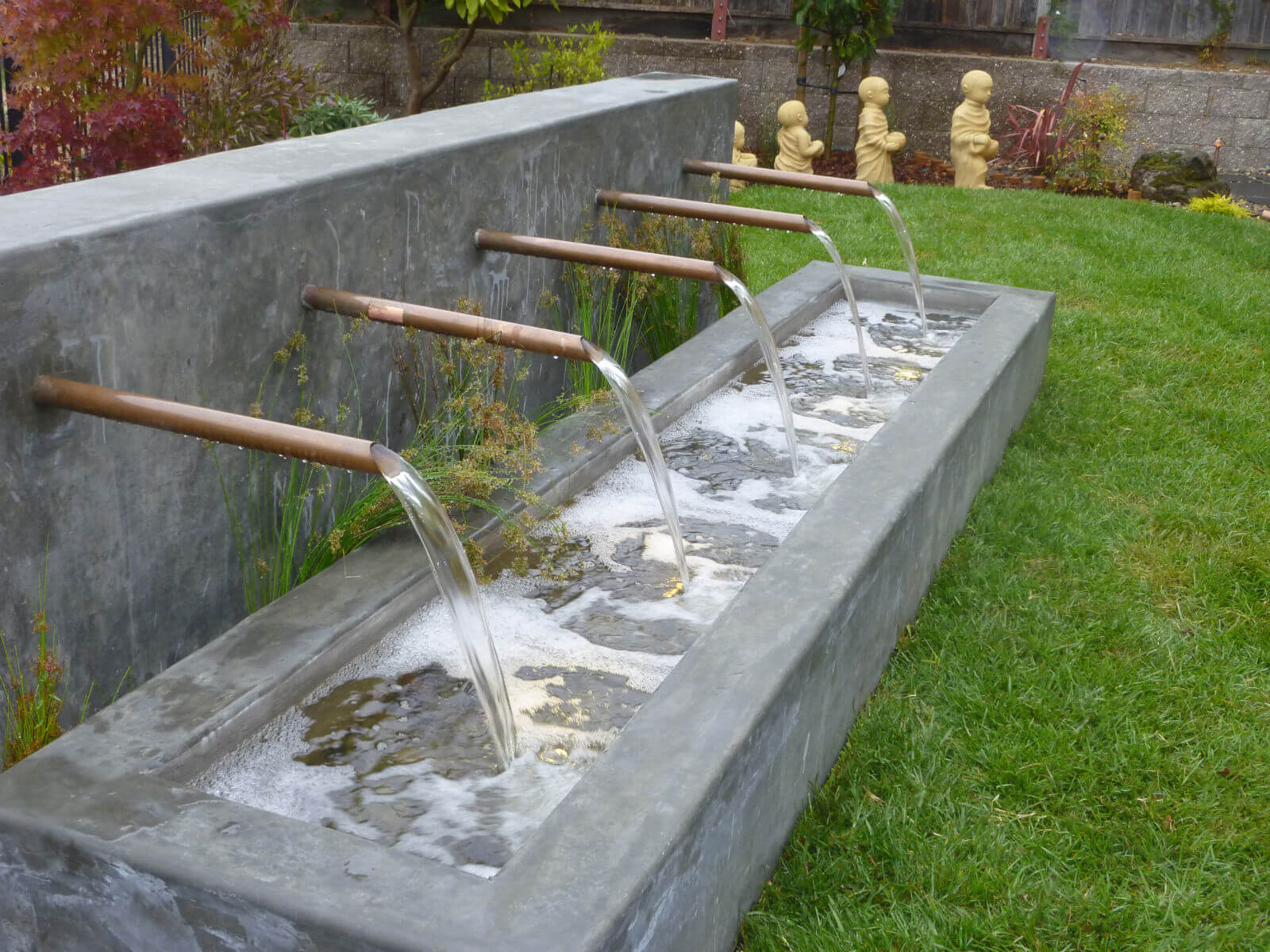
Because we can pour, cast, pigment, polish, stamp, seed, cut, or veneer it, concrete becomes both structure and design language. Concrete can support soil on a hillside, frame planting pockets, define outdoor rooms, add subtle borders, or anchor focal features like fire tables, custom fire pits, and water bowls.
Each variation solves a slightly different problem. Concrete’s versatility helps us complement the way you actually want to live outdoors: beautifully, comfortably, and with minimal maintenance. These concrete hardscaping ideas are a perfect example of how useful the material is.
Poured‑in‑place slabs give smooth, clean square footage.
A poured‑in‑place concrete slab gives you a clean, modern plane that we can broom‑finish for subtle traction, trowel smooth for a sleek look, or salt‑etch for a fine stippled texture. On patios, stoops, and garage aprons, we often add crisp saw‑cut grids or integral borders so the surface adds visual interest instead of giving the impression of “just a slab.”
Stamped textures can be made to look like masonry construction.
Stamped (textured) concrete lets us mimic flagstone walkways, brick walls, or even wood grain seating while keeping the strength, structural integrity, and single‑pour efficiency of concrete. Integrating color or layered stains adds depth, so entertaining terraces and pool decks look like hand‑set stone without the higher install cost or uneven joints.
Exposed‑aggregate finishes add traction and sparkle.
An exposed‑aggregate finish reveals embedded pebbles or crushed glass, creating natural sparkle and a slip‑resistant surface. This is ideal for garden paths, coastal or fog‑prone walks, and decorative drives. We can control the aggregate mix to look like nearby stonework and other types of masonry, or add subtle contrast to planting beds.
Colored concrete ties the hardscape into your home’s style.
With iron‑oxide pigments mixed through the batch, colored concrete carries hue all the way through. It never peels like surface paint. We use it for warm courtyard slabs, muted earth‑tone terraces, or accent bands inside larger pours so the hardscape looks like what it is – an extension of your home.
Pre‑cast pavers and tiles allow phased installation or future access to utilities.
Pre‑cast concrete pavers and large‑format tiles arrive factory‑made in consistent sizes and tones. This makes modular walkways, rooftop patios, and phased projects easy to extend or repair. Individual units can be lifted for access (for irrigation and drainage, for example) and replaced without touching the rest of the surface.
CMU blocks and segmental systems give retaining walls strength on San Francisco slopes.
Concrete masonry units (CMU) and modular wall systems provide a strong base for retaining walls, outdoor kitchens, and load‑bearing planters. Once reinforced and faced with stone, stucco, or plaster, they deliver both strength on San Francisco slopes and a polished finished look.
GFRC and specialty mixes allow additional masonry structures.
Glass‑fiber–reinforced concrete (GFRC) and other high‑performance mixes let us form thinner, lighter pieces. These elements would be too heavy in standard mixes. This is perfect for custom water features, floating bench edges, fire tables, countertops, and sculptural garden walls. They reduce weight while maintaining durability and crisp detailing.
Concrete provides an opportunity for decorative finish enhancements.
We can elevate concrete from “surface” to “feature” with built‑in detailing. For example, saw‑cut grids for modern rhythm, colored borders, and inlays of brick, stone, or steel are just a few ways we can upgrade concrete structures. These treatments are built into the concrete rather than glued on. They stand up to salt air, fog, and foot traffic far better than surface coatings.
Practical benefits make concrete hardscaping a smart investment.
Concrete earns its place in Bay Area landscapes as a highly useful hardscaping material because it quietly solves multiple problems at once. It serves to improve structure, longevity, design flexibility, accessibility, and cost control. Natural stone brings organic variation and wood offers immediate warmth. However, concrete balances aesthetics with performance in a way few materials can match.
Concrete pours into curves on tight urban lots, forms stable terraces on hillsides, and accepts colors and textures that echo surrounding architecture. It helps moderate evening temperatures, its low maintenance schedule frees you from constant upkeep, and its adaptability lets us integrate steps, seat walls, planters, lighting conduits, and drainage in a single coordinated build.
Add sustainable mix options such as extra cement materials or recycled stones, and concrete becomes not only practical but forward‑thinking. When you want a material that supports daily use, elevates design, and protects long‑term value, concrete is often the smart, quietly elegant choice.
- Durability – Properly placed concrete easily lasts 30 years or more; it won’t rot like wood or shift like loose stone.
- Low maintenance – An occasional wash and a five‑year sealer keep it looking fresh; no joints to weed, no grout to crack.
- Design flexibility – Curves, cantilevers, colors, and textures are limited mainly by the forms we build.
- Cost efficiency – Per square foot, poured concrete often runs 15‑25 % less than natural stone set in mortar, especially on large patios or long walls.
- Thermal mass – In our Bay Area micro‑climates, concrete absorbs warmth during the day and releases it in the evening, keeping outdoor rooms comfortable.
- Sustainability options – Supplementary cementitious materials (like fly ash) and recycled aggregates lower the carbon footprint while diverting waste from landfills.
You now have a clear view of today’s concrete formats and why concrete hardscaping outperforms many alternatives. In our follow‑up guide, we’ll show how we shape those formats into patios, walls, stairs, fire and water features, and the simple care routine that keeps them beautiful for decades.